
 New ArrivalsNEW
 Bestsellers
 TyohaarFESTIVE
 Co-ord Sets
 Dresses
 Bottoms
  Topwear
 Tops
Tops Shirts
 Jackets
 View All Topwear
 Shop By Collection
 Artsy
Artsy Rang (Tie-Dye)
 Print Dresses
 Basics
 Basics Top
 Basics Shirts
 Basics Dresses
 Basics Co-ords
 View All Basics
 On Sale
 Shop All
 Babli On You


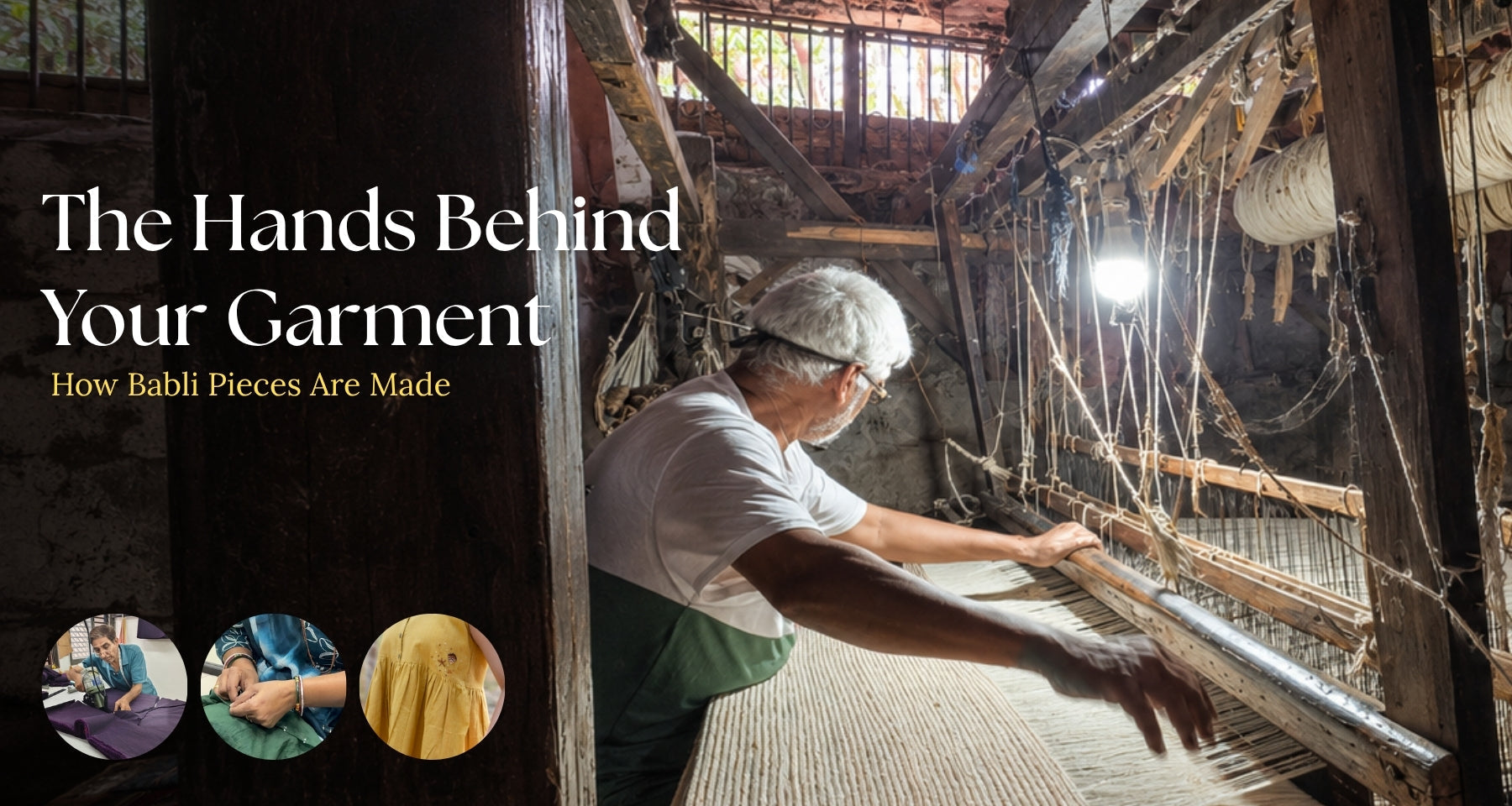
The Hands Behind Your Garment: How Babli Pieces Are Made
Let's start with something most of us never think about while getting dressed: someone made this. Not a machine that spat it out in thirty seconds, but an actual person, sitting somewhere, working with their hands, making the thing you're about to put on your body.
At Babli, that's not a marketing line. That's just how it works.
So we thought it was time to actually talk about it. What goes into a Babli piece before it lands in your cart, how many hands touch it along the way, and why we think this process is worth protecting even when it would be so much easier not to.

It Starts With the Fabric, Not the Design
Before there's a design, there's cotton. Handwoven cotton, to be specific, which is a whole different thing from the mass-produced fabric you'll find on a fast fashion rack.
Handloom weaving is slow by nature. A weaver sits at a loom and builds the fabric thread by thread, inch by inch. There's no shortcut for this. A machine can churn out metres of cloth in minutes, but a handloom weaver is working at the pace of human hands and human attention. That's exactly why it feels different when it's on you. It breathes differently, it moves differently, it ages differently, in a good way.
We've always respected this craft. It's part of the reason Babli exists in the first place, we come from a family that has admired the art of rural textile artisans for a long time, and we didn't want that to disappear into a world of synthetic, everything-looks-the-same clothing.

How Many Hands, Actually?
More than you'd think.
By the time a Babli piece reaches you, it's usually passed through the hands of a weaver, a dyer, a cutter, a tailor, and, for many of our pieces, an embroidery artisan who adds the hand-worked detailing you'll notice if you look closely. Each of these is a separate skill. None of it is automated. Every single stage is someone's craft, practiced and refined, often over years.
This is also why two Babli pieces from the same design will never be perfectly identical. A slight variation in the weave, a tiny shift in how the dye took, a stitch that's just a little different from the one before it. That's not a flaw. That's proof a real person made it, not a machine on a production line.

The Detail You Feel, Not See
Here's the thing about hand embroidery and handloom fabric, you don't always notice it the moment you see the product photo online. What you notice is later. When you're wearing it. When the fabric feels different against your skin than anything you've worn before. When the embroidery has a texture and depth that printed patterns simply can't fake.
That's the kind of detail that's easy to miss and impossible to forget once you've felt it. It's what makes people come back to a piece, and to a brand, long after the first wear.

Why We Do It This Way
We're not going to pretend handloom is the "easy" choice. It costs more, it takes longer, and it would honestly be simpler for us to switch to mass-manufactured fabric and cut our production time in half.
But that's not the brand we set out to build.
Responsible and organic fashion is something we consider part of our heritage, not a trend we picked up because it looks good in a caption. We believe our approach only has value when real people can truly be part of it—both the artisans making the clothes and the women wearing them. That's why we focus on fair work, honest fabrics, and clothing that's genuinely affordable, bringing all three together. It's not always easy to strike that balance, but it's the whole point.

What This Means for the Artisans
For the artisans we work with, handloom and hand embroidery aren't just a job, they're a skill passed down, often through generations, that doesn't always get the recognition or the fair pay it deserves. Every Babli order that goes out is, in a small way, a vote for that skill to keep being worth something. For the craft to keep being practiced instead of being pushed aside for something faster and cheaper.
It's easy to lose sight of that when you're scrolling and adding things to cart. So this is just us asking you to pause for a second, next time you put on something handwoven or hand-embroidered, and remember there were real hands, real hours, and real care behind it.

FAQs
1. What does "handwoven cotton" actually mean?
It means the fabric is woven on a handloom by an artisan, thread by thread, instead of being produced on an industrial power loom. It's slower, but it results in a fabric with more texture, breathability, and character.
2. Why do handmade pieces have slight variations?
Because they're made by hand, not machine. Small differences in weave, dye, or stitching are a natural part of the process, and proof that a real person made your garment.
3. Is handloom clothing more eco-friendly?
Yes. Handloom weaving uses far less energy than power looms and directly supports rural artisan livelihoods, making it both an environmentally and socially responsible choice
4. Does Babli use hand embroidery on all its pieces?
Many of our pieces feature hand embroidery and handcrafted detailing. You'll usually find this called out in the product description, so you know exactly what you're getting.